
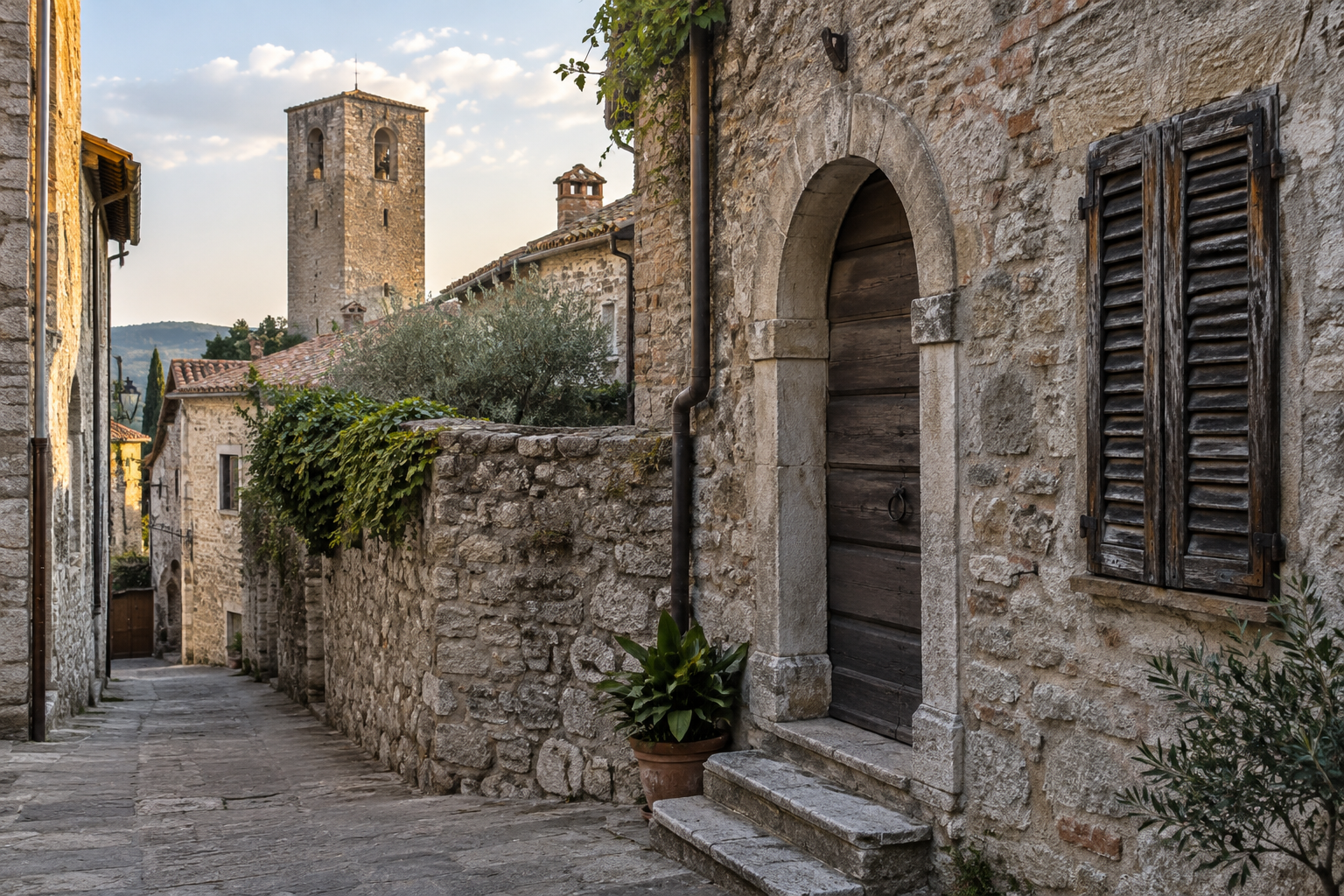
A home can be a street number, a courtyard, a farmstead, a room over a shop. In family records, though, a home is often a fixed point. You see it in the same street returning, in a district name misspelled by a priest, in the phrase “late son of” followed by the name of a man already dead. That is why surnames such as Casa, Casale, Palazzo and Torre make people look more closely at the places where their family lived.
The temptation is obvious: Casa must come from a house, Torre from a tower. Sometimes the lead is good. A common word, however, can have many lives. It may refer to a building, a place, a nickname or an origin. It may have settled in a generation that records no longer let us reach.
You do not have to solve it at once. Take the first reliable record and notice the residence. Then the next one. When your ancestors stay in the same spot for decades, you have a fact. The hypothesis about the surname comes afterward.
Casa: a small word with many possible stories
Casa may seem too general to help. Yet when it appears beside a district or estate name, it can take shape. A baptism may say “at the Casa”; a contract may mention a house with a garden; an inheritance may distinguish the old house from the new one. Modest words, but they show where people moved.
Case, Casale, Casali, Casini and Casati look closely related at first sight. Do not treat them that way too early. Singular, plural and suffixes can shift in spelling; they can also belong to families that began in different places. Compare ages, parents and witnesses. They tell you whether one form truly leads to another.
What is worth looking for
In parish records, look for the residence; in marriages, the origins of the couple; in death records, who reported the death. When the same neighbour repeatedly appears beside your family, write it down. A story of home also runs through these people: those who shared a courtyard, a road or the same fields.
Towers, walls and palaces do not always name a building
Torre and Torri may recall a very visible structure. In many Italian towns, a tower was a practical landmark: people arranged to meet there, named property after it, or recognized people living nearby. The surname may have kept the word long after the tower stopped mattering in the family’s life.
With Mura, the reasoning is similar. Walls could mark a boundary, a part of the town, or a house built against the enclosure. There is no need to imagine an important family or a special dwelling at once. Sometimes the most useful connection is an old residence description, found almost by chance in a notarial record.
Palazzo and Palazzi need the same care. Today the word suggests something grand. In local speech, it may have meant a familiar building, a part of town, or a house simply known by that name. Context brings many attractive ideas back to size.
Before drawing a tower on your family tree
A surname linked with homes and buildings becomes useful when it meets a solid trace. A Villa family living for generations near a place called Villa offers a lead worth checking. A Borgo family moving from one hamlet to another may instead tell a story of origin, or of a nickname given by the people who received them.
Keep a note of the surname forms and the exact places. Even a modern house number may help recover continuity when you compare it with newer maps and records. Then move backward slowly. You may never find the house where it all began. You can still learn how a family made a place for itself in the world.
When an address changes, do not discard it. Streets are renamed, hamlets move between municipalities, a house is divided or absorbed into a nearby building. Follow the people before following the place name. A Casini who returns with the same siblings and godparents may still belong to your line even when the residence is described differently. Continuity in archives rarely comes from one detail alone.

Leave a Reply