
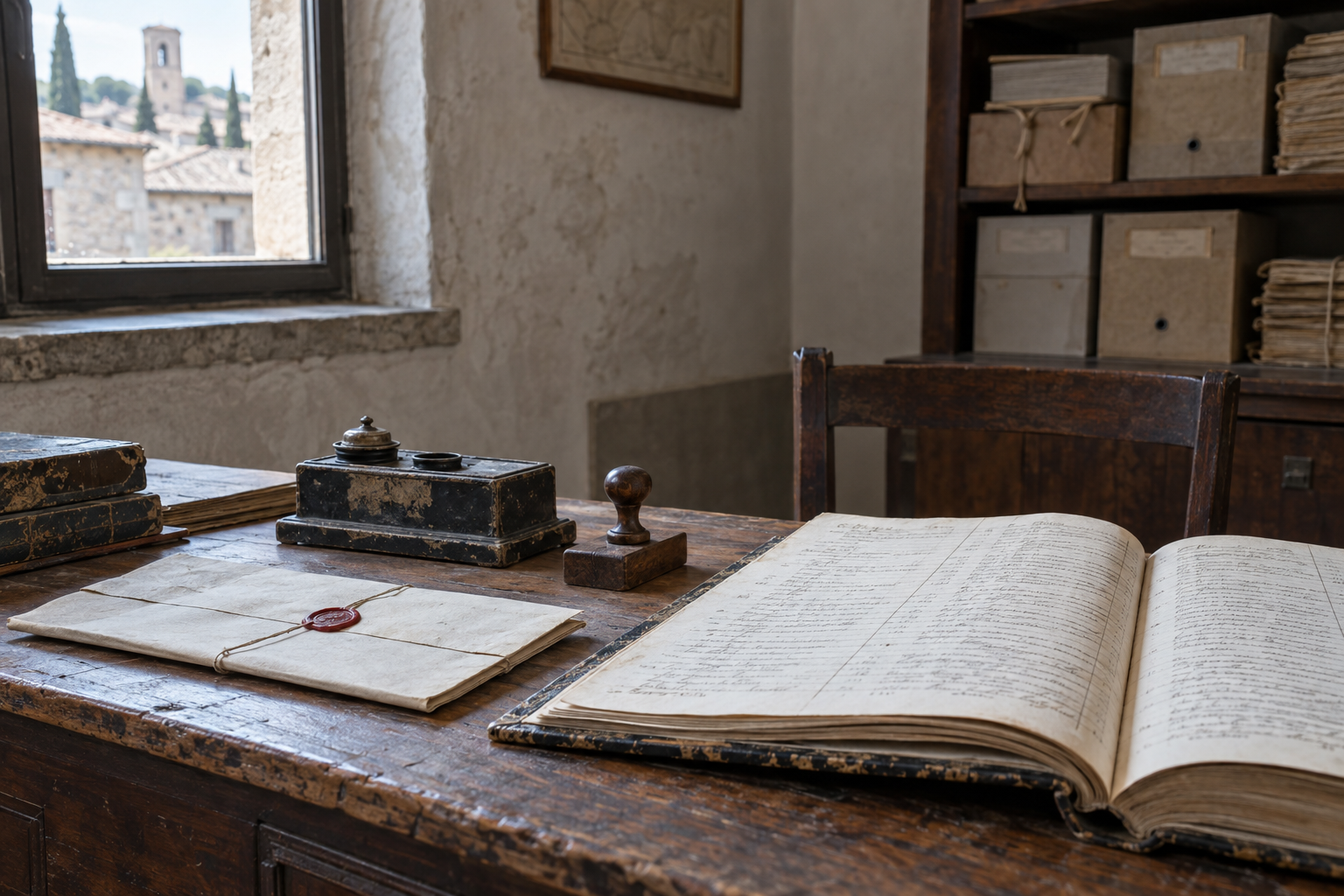
In a birth record or a contract, you may come across words that sound important: notary, judge, captain, consul, mayor. Sometimes they really are the trade or office of the person described. At other times, many years later, those words have become a surname. Nothing about that is automatic. Family research can go off course when a name is read as a ready-made biography.
Notaro, Notari, Giudice, Giudici, Capitano and Consoli all contain a word of office or responsibility. That may be a lead. It is neither a patent of nobility nor proof that an ancestor held the position.
A name at the bottom of a record
Take a nineteenth-century marriage record. It gives the couple, parents, ages, trades and witnesses. If one of them is called Notaro, look at what surrounds the name: is he actually described as a notary? Does he sign in a distinctive hand? Does he live in one particular part of town? Is he linked with other clerks or landowners? The surname opens a door; the record decides how far you can go through it.
In towns, offices also lived in everyday speech. A man could be known by a role held by himself, his father or one side of the family. Over time, the first meaning faded and the form remained. That is why two families with the same surname may have beginnings far apart from each other.
Notaro and Notari
Notaro is a surname that immediately suggests a desk, registers and signatures. In some cases there may well be a link with someone who drew up legal acts. It would be careless, though, to assign that role to every Notaro ancestor without finding it in writing. Look for occupations, deeds, references in inventories, or municipal records. If they do not appear, the surname still belongs to the story; it is simply harder to explain.
With Notari, the resemblance is obvious, but it does not require merging branches. A final letter may change in a priest’s hand; it may also mark a different family. Ages, mothers, godparents and homes matter here. The usual details, yes. They are what keep a tree standing.
Giudice, Giudici, Capitano
Giudice and Giudici may point toward a judicial function, but also toward a nickname or a local family memory. Capitano and Capitani raise the same question. The word calls up command, yet through time it might have referred to a military, civil or local post, or simply to someone people called that way.
An office is not inherited like a surname
The simplest proof is to look at your ancestors’ real occupations. A Capitani family may include farmers, blacksmiths, builders and innkeepers for generations. There is no contradiction. The surname may have begun much earlier, or in another line, and then continued while everyday life changed completely.
Other surnames, such as Sindaco, Senatore, Magistris and De Magistris, need the same calm approach. The words can sound grand. Research remains very concrete: date, place, relationship, next document.
When you find a person with one of these surnames, note every title that the record actually gives them. Then compare the people around them. A witness who appears repeatedly, a neighbour, a relative who arrived from a nearby town: that is often where a checkable connection appears. Not in the large word of the surname.
You may eventually find a notary, an officer or an administrator. You may also find a long line of ordinary people bearing a name born from a history that can no longer be reconstructed. Both possibilities deserve respect. Archives do not promise a legend. They promise traces.
One simple check often prevents mistakes: try to follow one person through at least three consecutive records. When the same Notaro appears as a farmer at a child’s baptism, as a labourer at a daughter’s marriage, and as a landowner in his death record, you have a small documented story. The surname does not replace it; it merely makes the question of its origin more interesting.
Watch for children given the same name as their grandfather, too. In a small town, Giudice, Capitano or Sindaco may appear many times in one generation. Comparing dates, homes and wives’ names remains the safest route.

Leave a Reply