
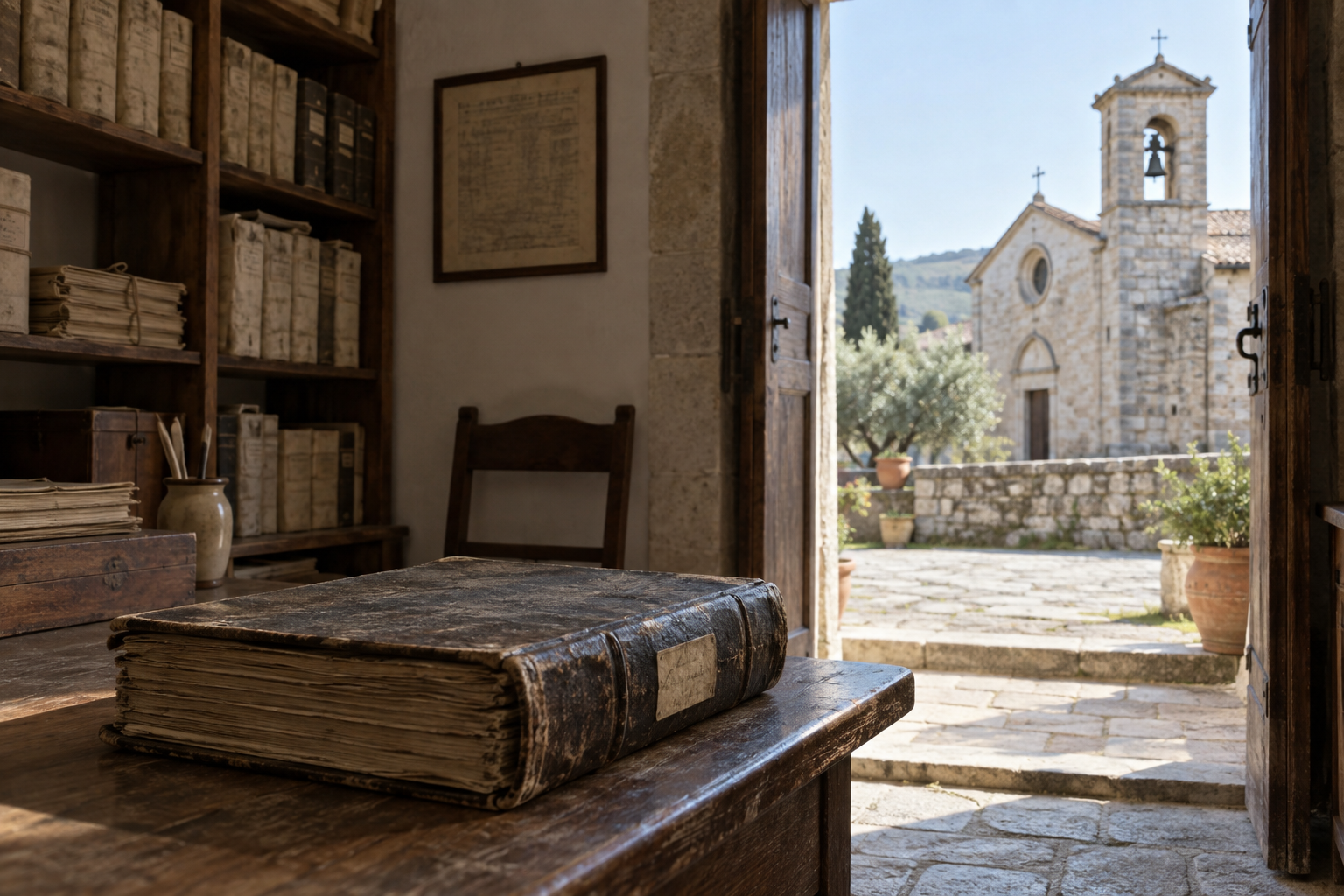
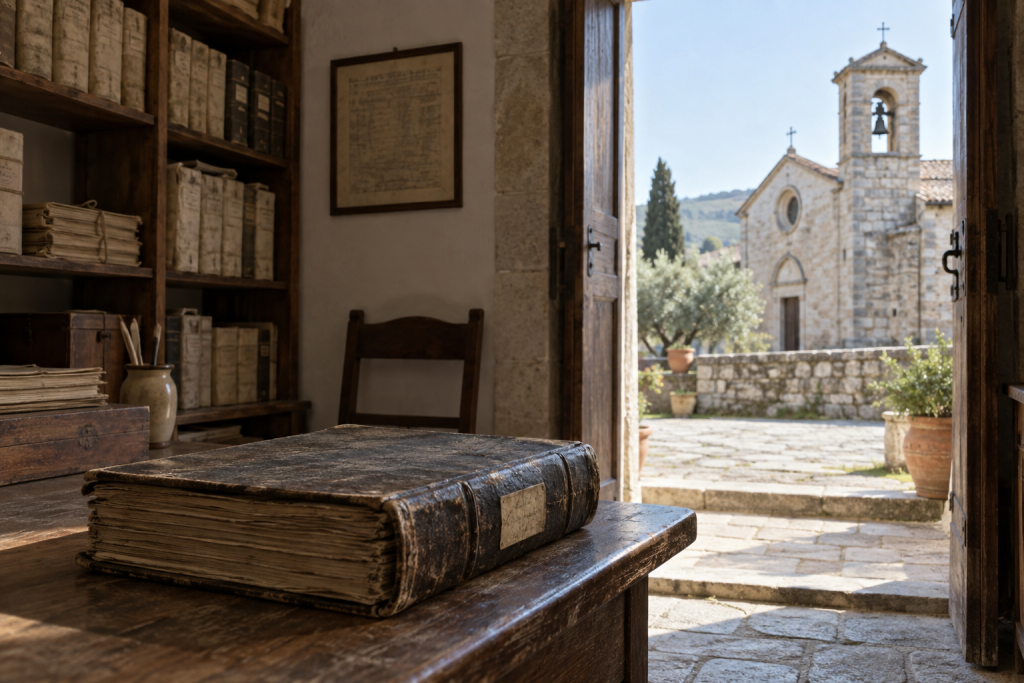
In many Italian families, a baptism was more than a date. It was the day when the priest, godparents, a saint chosen through tradition or affection, and a network of relatives all came into view. Those people often appear again decades later at a marriage or in a death record. That is why surnames that seem to recall saints, feast days and devotion attract so much attention in family history research.
Santi, Santo, Santini, Santoro and Santucci seem to gather around the same word. In practice, each may have taken a very different path. One form may grow from a personal name, another from a nickname, another from local custom or a calendar feast. The shared sound is interesting. It is not proof of kinship.
Look closely at the oldest records you have, not only at the heading of the act but at the lines around it: who holds the child, who signs, where the family lives, which parish recorded the event. In a small town, the people who keep returning beside one family can say more than a quick explanation of the surname.
Picture a baptism in the middle of the nineteenth century. A child is called Giuseppe, his father is a mason, his mother comes from a nearby hamlet; the godfather is a De Santis, and he turns up again twenty years later at the marriage of a sister. It does not prove that every De Santis in the area is related. It does offer a real thread: perhaps a maternal connection, an old neighbourhood, perhaps work shared over time. Records open that way, through small gaps.
A surname such as De Santo may make you want to treat it at once as a version of De Santis. Pause. The particle may be stable, disappear, be joined or separated by the writer’s hand; that does not mean every nearby form belongs to the same line. Before joining two people, look for continuity: parents’ names, believable ages, a home, recognizable siblings.
The saint’s name may already be in the family
In some homes, certain names recur stubbornly: Antonio, Francesco, Michele, Maria. Sometimes they come from a grandparent; sometimes from local devotion; sometimes from a promise made in a hard moment. If your surname is Angelo or Angeli, that pattern of names is worth noticing, not forcing. One record may give Angelo as a baptismal name and Angeli as the surname of another family on the same page. It happens.
Serafini has an even clearer religious sound. Still, the research does not stop at the word. Follow the form in the registers. Does Serafini remain unchanged? Does it shift? Does it appear with a family that arrived from elsewhere? A move of only a few miles, at the right point in time, can explain a presence that once looked mysterious.
Then there are surnames such as Croce and Crocetti. It is natural to think of the religious symbol. It may be a sensible lead, but it is not enough. A name like this could also come from a place, a sign, a chapel, or a wayside cross used by everyone as a landmark. Land and notarial records sometimes preserve these small directions: “by the cross,” “near the chapel,” “in the district.” They will not always be there. When they are, stop and read them.
Madonna is another kind of case. Today the word stands out because we hear it almost only in a religious setting. With surnames, though, it is unwise to react with today’s associations. A family may have received the form through devotion, proximity to a place, a house name, or a reason that is now hidden. Saying “it means this” would be convenient. It would also be too little.
Di Dio and Diodato deserve the same slow pace. Spaces, apostrophes and particles are often what make a person disappear during research. A modern index may give one form; a handwritten register may give another, or split the same word across a line. Search plausible spellings, but keep the results separate until you know who they belong to.
The useful question is not “what does it mean?”
The useful question is: where and with whom does my family first appear? Begin with the safest record and work backward. With a Santoro, note the town, parish, trade and godparents. When you find a Santini, do not turn that person into a Santi simply to make the search easier. You need dates and people that line up, not just an impression.
This type of surname often leads toward parish registers, but not only there. Military draft lists can show a young man leaving the town; a civil marriage can give an exact address; a will may name a chapel, a gift, or a relationship that was unclear in baptisms. Do not search for one perfect document. Look for records that speak to each other.
You may eventually find a precise explanation for the religious sound of the surname. You may never find it, and still build a sound family history. That is not a failure. The important thing is not to let one suggestive word replace the real people you meet, page after page.

Leave a Reply