
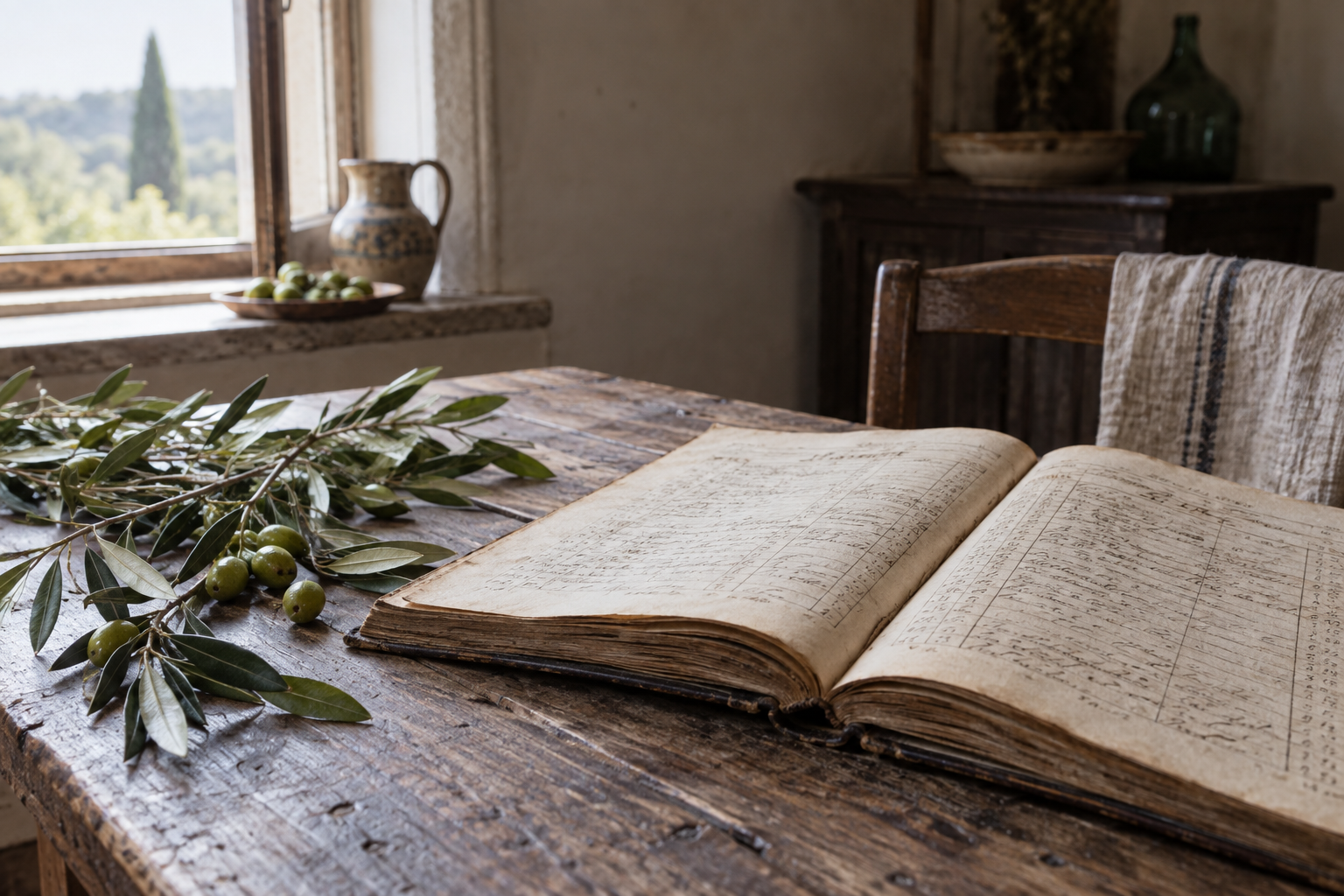
Some surnames sound as though they came from an orchard, a row of trees, or a garden behind a house. Castagno, Palma, Pini, Rosa. They are familiar words, and that is exactly why it is easy to give them a meaning too quickly.
A surname like this may recall a plant near a home, a spot in the village, a trade, a nickname, or an old personal name that became part of a family line. Sometimes the link with nature is real. Sometimes it was already fading before the records we can reach began. Start with the form written in the documents. Start there every time.
A tree behind the name
Castagno feels very tangible. It brings to mind places where chestnut trees supplied wood, food, shade and work, but it does not require us to imagine a farming family. It may have been a handy way to identify someone: the person living near a chestnut tree, someone from a district with that name, or someone carrying an older nickname.
With Pini and Pino, the question shifts a little. Singular and plural are not minor details. In a run of records they may be one line with changing spelling, or two nearby but separate families. Do not decide from the surname alone. Check parents, ages, homes and witnesses. Slow work, yes. It keeps the family tree from taking a wrong turn.
One useful detail is the district name. In early baptisms it may appear almost in passing, beside the residence. On maps and land records it can become much clearer. When a Castagno family stays in the same small area for generations, the word may become more than a tempting idea.
Palma: one word, several paths
Palma may call up a tree, but it can also be an old given name. Some lines may have a religious or hopeful history; for others it may simply be a personal name that settled into use as a surname. There is no need to choose the neatest explanation at once. Find where the first Palma people in your line appear, and see how the records name them.
Palmieri is not merely “Palma with something added.” The resemblance invites the comparison, but it does not prove that one became the other. In some areas related forms have lived side by side for centuries without belonging to the same branch. The usual mistake is skipping a generation because a name looks familiar. Better pause.
Fruit, colour, nicknames
Fico and Fichi lead in another direction. A fruit can enter a surname for many reasons: a tree near a house, market work, a trait given to somebody, a local use of a word that has since disappeared. The word does not come with a certificate of origin. It comes with a question.
The same is true of Meloni. In the papers, however, look beyond the name at the top. A marriage record may tell you whether the family lived in the countryside or in a town; an inventory may show a house, a garden or a shop. Small things. They give the search some ground under its feet.
Not every surname that calls up a plant came from farm work. That is probably the most useful warning. In communities where the same everyday words were shared by everyone, a nickname could appear quickly and then last for generations.
Rosa, Mori and Moro: handle resemblance carefully
Rosa may seem the easiest name to read. Yet it can be a woman’s name, a floral reference, a nickname, or a form linked with devotion. Rose looks close, naturally, without necessarily being its variant. Old spelling can be troublesome: one vowel may shift, but a family may also keep its own form from beginning to end.
Mori and Moro do not automatically speak of trees or fruit, even though their sound can be misleading. Read them slowly, inside their local history. When a record puts a Moro near a Mori, do not join them in your tree until a document actually builds the bridge.
Where to begin, for real
Take the most recent document where the surname is certain. Copy the exact form, the town, the hamlet if it is given, the parents’ names and the occupation. Then work back. When the surname changes, write it down without correcting it too soon. A note in a margin can matter as much as a beautiful theory about the name’s origin.
After a few generations, the landscape of the place begins to come into view: chestnut country, a road, an estate, a market, a saint with a strong local presence. Perhaps the link with the surname holds. Perhaps it does not. Both outcomes are useful. Family history lives in records, people and the places where they left a trace.

Leave a Reply